
Tag: here be the void
jointphotographicexportsgroup:
LIGHT THIS MOTHERFUCKER UP!!!
this episode made television history for fastest facial hue change by an adult male comedian
get a green thumb
basic gardening guide for indoor gardeners
climate & light
- Research your climate zone [usa] [ca]. Buy plants that are recommended for your climate zone.
- Note the sunniness of where you are going to grow your plants.
- no direct sun at all (still needs ambient light) = full shade
- sun in morning/evening shade for rest of the day = part shade
- sun all day = full sun
- shade in morning/sun for rest of the day = sunny, part sun
- follow these guidelines:
- south window = sunny, part sun, sometimes full sun
- east window = part shade
- west window = part shade
- north window = full shade
- sun bulbs can be purchased to encourage indoor growth.
- indoor plants used to low light might easily burn and dehydrate if left in full sun for too long, even if they are normally hardy plants.
soil & drainage
- basic potting soil or gardening soil is “universal” for almost all plants.
- major exception:
- cactus & succulents = rocky, sandy, succulent soil is necessary for proper drainage
- all plants need proper drainage or else they will ‘drown’. Choose only containers with holes in the bottom. Use a thin layer of rocks and/or gravel at the bottom of containers to ensure the hole is not clogged with soil.
watering
- water less = cooler, cloudy, low wind, humid, rainy.
- water more = warmer, sunny, windy, dry, no rain.
- note the type of container you have used.
- dries out more slowly, water less = metal, plastic, glazed ceramic, light colors in sunlight, nonporous.
- dries out more quickly, water more = terracotta, wood, moss, dark colors in sunlight, porous.
- indoor gardeners, plants with smaller root systems need less water. Watering them more will drown them; not encourage them to grow. The roots cannot drain the soil and the water will sit, drowning the tender root system 😦 this applies primarily to container gardening.
- no need to water daily. water when the plant tells you it is ready:
- its leaves droop (aim to water a day before this hits!)
- it begins to stop being glossy and starts looking a bit drab
- the soil is dry 1 to 2 inches down
- the pot is lighter because the soil is dry (lift pots before and after watering to compare)
- you want your plant’s root ball to be moist.
- when roots dry, they shrink, pulling away from the edges of the pot.
- when you add water to the pot, it follows the path of least resistance around the edges of the pot, straight past the root system.
- to fix this, soak the plant once in water. then, water again.
- if a plant is not seeming to be hydrated no matter how much you water, it is possible all your water is draining off to the sides and never reaching the actual root ball. to fix:
- soak thoroughly in water several times.
- place your container in a tray of water and let osmosis or whatever suck that water right up straight to the root.
- avoid frequent, small waterings. this encourages the plant’s roots to grow too close to the surface. It is best to thoroughly water plants then let them dry out slightly before you water again (no need to let the leaves droop or anything – just wait until the plant is ready again, as described above).
getting a plant from a nursery
- choose smaller plants as long as they are healthy.
- smaller plant = smaller root system, healthy.
- larger plant = big root system, curled and unhealthy in small commercial pot.
- young plants with fruit or flowers = prematurely grown, highly stressed, unhealthy.
- healthy plants have several identifiable traits.
- they are colorful and lush
- they are firm and do not have mushy stems or leaves
- they have thick white roots
- they are free of brown, white, or yellow spots
- they are free of bug bites and infestation
transplanting a new plant to a pot
- get the right sized pot.
- too big = easily drown plant in soil that cannot drain.
- too small = root system curls in an unhealthy way, not properly sized.
- the “right sized” pot is based on the current size and future growth of the plant.
- if a plant is 10-12 inches tall, give it an 8 inch diameter pot.
- if the plant is 2-3 feet tall, give it a 24 inch diameter pot.
- with a new nursery plant, get a container giving about 2 extra inches on each side of the plant.
- get a container tall enough that you can have 2 inches of soil at the bottom of the container, a plant, and one inch of space between the topsoil and the lip of the container. This gives you plenty of room to water!
- ensure your drainage hole is properly covered with mesh or a stone to prevent soil from falling out or clogging it.
- moisten your potting soil if it is really dry. Mix some in a pail or bucket with water until it has the texture of a squeezed sponge.
- ensure the nursery plant is damp enough to transplant. If the soil is too dry the root system will not hold the dirt together and everything will just fall apart (!!!). Soak your nursery plant for 30 minutes in water.
- fill the space around the plant with potting soil, leaving one inch of free container space above the plant.
- although the soil and plant should both be damp, you must now water your transplanted baby to ensure all air pockets are eliminated and that the soil has settled around the root ball.
- even if plant is “full sun” do not simply place a young plant right outside for hours and hours. “Harden off” plants by slowly introducing them to the sun for an hour at a time and progressing over a course of days until they are ready for full sun.
enjoy plants :3
extensively plagiarized from Container Gardening for Dummies
how to really get to know someone:
– look at their handwriting
– read their favourite book and search for pieces of them within the pages
– listen to their music and let it resonate with you
– go to their favourite place
– stay up ‘till 3am and let them spill their heart out to you
– ask them unusual questions that you never even thought would intrigue you
– spend a day with them doing nothing
– look out for the things they subconsciously do when they’re happy
– watch how their smile forms
– go through old photos with them
– use their body wash when you shower at the persons place (truly, you’ll feel it)
– talk to their parents, grandparents or siblings
I love the ones added ❤
-Make them laugh and learn their different laughs (my personal fave to share with someone is the sleepy-drunk laugh)
– make art with them, sitting in the silence just drawing or painting, or having deep conversations while making art, both realllyyy connect them
– spent time with their pets (but not too much because they might be jealous)
– notice how they squeeze the toothpaste bottle.– let them tell you their dreams and ask if you can look it up for them, share the results.
– learn their impulse buys/decisions
^^^ ahhh these are so cute!!
A deleted song from Lord of the Rings
This song, Use Well the Days, was written for the ROTK end credits. You won’t find it anywhere in the soundtrack- It was cut after Into the West took its place. (this recording may not be the “final draft” of the song, either.) Just like Into the West, it was composed by Howard Shore and sung by Annie Lennox, with lyrics by Fran Walsh.
Use Well the Days is about Frodo bidding his final farewell to Sam…. thanking him, blessing him, and hoping the rest of his life in Middle Earth will be happy and peaceful.
(Source: https://www.youtube.com/)
I have so many emotions about D&D all the time tbh, like there is no end to how grateful I am that crusty nerdbros no longer have the stranglehold on it that they used to. It’s the kind of thing that in the past I unfortunately associated mainly with those GamerGate-type dudes who are all about racking up orc kills and rolling seduction checks on women in bikini armor.
My entire world changed when I discovered that it didn’t have to be that way. At its core, D&D is a wonderfully accessible form of collaborative storytelling, and in the hands of marginalized communities and their allies that is so incredibly powerful. Between the three D&D podcasts I listen to, and the campaign I play with my own group of friends, I’ve been provided with this affirmation, representation, and sense of community that I have yet to truly encounter in any other type of media, and I’m gonna be gushing about that for the entirety of the foreseeable future tbh.
crusty nerdbros never had a total stranglehold on it
you were lied to
lgbt ppl, poc, women, disabled people, all kinds of multiply marginalized people have always been in this hobby. I’m a queer black woman who has DM’d for 20 years. we fought for years to carve out spaces that were hostile to us, writing letters to the editor and essays, fighting on Usenet and message boards, walking out of shops and GenCon panels, creating our own homebrew groups in a time when it was not nearly as easy to find like minded people
the current renaissance you’re seeing is a direct result of our efforts over the last 20-30 years challenging the misogynist, racist, homophobic culture of tabletop gaming, often thanklessly, and frequently invisible
i’m really happy that more people are involved in D&D now and feel welcome, please don’t mistake this as some “get off my lawn” screed. this is all I ever wanted for this hobby. but please recognize how and why that happened. please recognize that it took a lot of pain and suffering and some of the people who fought these battles were so scarred and exhausted that they left the hobby entirely and are not here to enjoy the fruits of their labor. and also, please recognize that there is more to be done, and support other gamers who are doing so, not just the handful of allegedly “woke” white bros taking credit for our labor
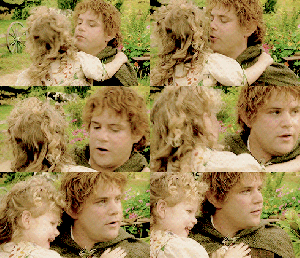
MY FAVOURITE TOLKIEN CHARACTERS | [14/15] » Samwise Gamgee
∟ The brave things in the old tales and songs, Mr. Frodo: adventures, as I used to call them. I used to think that they were things the wonderful folk of the stories went out and looked for, because they wanted them, because they were exciting and life was a bit dull, a kind of a sport, as you might say. But that’s not the way of it with the tales that really mattered, or the ones that stay in the mind. Folk seem to have been just landed in them, usually – their paths were laid that way, as you put it. But I expect they had lots of chances, like us, of turning back, only they didn’t.
 I feel the mountains burn inside