My face is having uncontrollable spasms. Great. It hurts really, really, really bad.
I think part of why I have trouble explaining pain to the doctor is when they ask about the pain scale I always think “Well, if someone threw me down a flight of stairs right now or punched me a few times, it would definitely hurt a lot more” so I end up saying a low number. I was reading an article that said that “10” is the most commonly reported number and that is baffling to me. When I woke up from surgery with an 8" incision in my body and I could hardly even speak, I was in the most horrific pain of my life but I said “6” because I thought “Well, if you hit me in the stomach, it would be worse.”
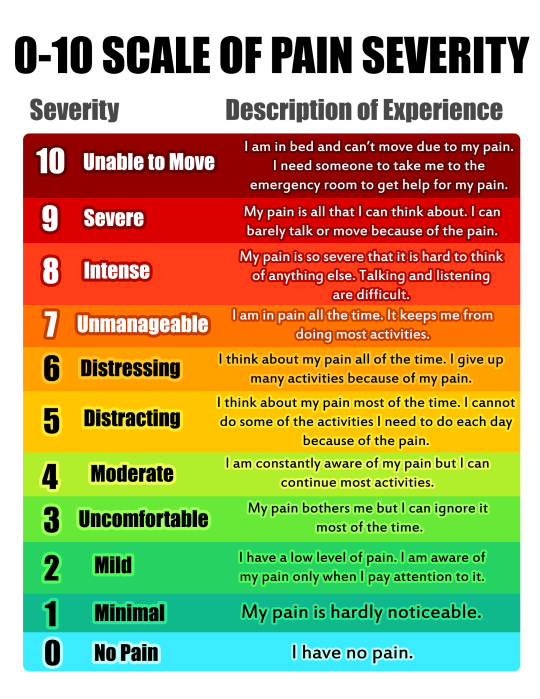
I searched and searched for the post this graphic was from, and the OP deactivated, but I kept the graphic, because my BFF does the same thing, uses her imagination to come up with the worst pain she can imagine and pegs her “10″ there, and so is like, well, I’m conscious, so this must be a 5, and then the doctors don’t take her seriously. (And she then does things like driving herself to the hospital while in the process of giving birth. Probably should have called an ambulance for that one!)
So I found this and sent it to her. Because this is what they want to know: how badly is this pain affecting you? Not on a scale of “nothing” to “how I’d imagine it’d feel if bears were eating my still-living guts while I was on fire”.
I hate reposting stuff, but I’ll never find that post again and OP is deactivated, so, here’s a repost. I can delete this later, i just wanted to get it to you and I can’t embed images in a chat or an ask.
This is possibly why it took several weeks to diagnose my fractured spine.
Pain Scale transcription:
10 – I am in bed and I can’t move due to my pain. I need someone to take me to the emergency room because of my pain.
9 – My pain is all that I can think about. I can barely move or talk because of my pain.
8 – My pain is so severe that it is difficult to think of anything else. Talking and listening are difficult.
7 – I am in pain all the time. It keeps me from doing most activities.
6 – I think about my pain all of the time. I give up many activities because of my pain.
5 – I think about my pain most of the time. I cannot do some of the activities I need to do each day because of the pain.
4 – I am constantly aware of my pain but can continue most activities.
3 – My pain bothers me but I can ignore it most of the time.
2 – I have a low level of pain. I am aware of my pain only when I pay attention to it.
1 – My pain is hardly noticeable.
0 – I have no pain.
It’s also really important to get this kind of scale to people who have chronic pain, because chronic pain drastically lowers your perception of how “bad” any kind of pain actually is, and yet something like this pain scale is extremely user friendly.
For example, if someone asked me how much pain I’m in at any given time, I’d say hardly any, and yet I’m apparently at a chronic 2.5, and it only goes up from there depending on the day.
— “Conflict. As the world tethered on the brink of anarchy a new hope arose. An elite international taskforce, charged with ending the war and restoring liberty to all nations. Overwatch. Soldiers. Scientists. Adventurers. Oddities. Guardians who secured global peace for a generation. Under its steadfast protection the world recovered. And today, though its watch has ended, its sowing ideals of freedom and equality will never be forgotten.”
Here’s a list of random joke items to use for fun in your campaign. I’d recommend adding them to treasure hoards rather than subbing normal items for them.
Anyway here they are:
1. Ace of Spades – An ace of spades from a standard card deck. No matter where you store it on your body, you will always be able to find it in your right sleeve afterwards.
2. Amulet of Extra Amulet Slot – This amulet allows you to gain the benefit from two magical amulets rather than one. It cannot be further enchanted.
3. Amulet of Feather Fall – When worn, this amulet turns into a feather and falls to the ground.
4. Amulet of Unbreaking Bones – Con-man says you can’t break any bones. Really, he means other’s bones. -100% damage against skeletons.
5. Amulet of weather detection – yells that it is or is not raining.
6. Anti-Matches – A box of matches. Striking one will make it begin to drip water from the tip while the match shrivels away. The amount of water a match releases is about enough to fill a tablespoon.
7. Arrow of Euarere – A silver arrow, suspended on a string. It always points to the person holding the string.
8. Arrow of Slaying, The – This magical arrow is capable of killing a creature.
9. Artist’s Bludgeon, The – Inanimate objects hit with this bludgeon will receive no damage; they will however change color.
10. Attentive Guardsman’s Pike – These ornate and deadly-looking ceremonial pikes are reach weapons and appear to weigh at least 20 lbs, not counting the weight of the fluttering banners that can be unfurled for parade use. Constructed of shadowstuff, they weigh one pound, and inflict only a single point of damage on an attack, being almost entirely for show, although they also have the unique property of remaining in place when set (although unable to support more than 20 lbs), allowing a ‘resting his eyes’ guardsman to prop it up and leave it standing under its own power, while his hand sags off of it.
11. Attentive Guardsman’s Tabard – A dozen of these tabards were fashioned for palace guardsmen in the Empire of Sard, 250 miles from the nearest enemy. The bearer is placed under a glamour that causes him to appear alert and awake, even if his eyes are closed and he is snoring lightly.
12. Axe of Big Numbers – This axe shouts “Big numbers baby, come on!” whenever it is swung, but always deals 1 damage or less.
13. Axe of Empathy – Every time you hit something with this +5 greataxe, you get dealt an equal amount of damage. Both you and the thing you hit are then healed the amount of damage dealt by the axe, even if either are dead. The Axe hopes you have learned your lesson.
14. Axe of Pain – The axe is always moaning and groaning with pain.
15. Bag of Faerie Gold – This sack appears to be full of gold coins and jewels. When one attempts to spend them, however, the glamour on them soon vanishes, revealing them to be nothing but leaves and pebbles. Obviously, most shopkeepers will not be happy about this, and no amount of ‘we didn’t know, I swear!’ will change their mind.
16. Bag of Holding – This item functions as a normal backpack, however when attempting to retrieve an item, a calm female voice tells them there is a wait time of 4d10 minutes before they can retrieve their item (actual time is stated time plus 6d6 additional minutes). During this wait, the bag plays either annoying muzak or advertisements for the bag’s creator’s other products/services. Upon attempting to retrieve an item, there is a chance that the wrong item is retrieved, or that the intended item is simply missing. Obtaining the original item requires an additional 4d10+6d6 minutes and has only a 5% chance of success.
17. Bag of Trading – You can take one thing out of the bag for each object you put in the bag. However, you have no control over what you get, and there are no trade-backs. Past research seems to imply there’s some sort of correlation to what gets you what, but it’s extremely convoluted and far from understood.
18. Bag of Trick – This bag operates like a Bag of Tricks, except it only works once a week and produces a rat each time it is used.
19. Bag of Unholding – Quite a large backpack but even the smallest item doesn’t fit.
20. Bagpipe of Stealth – Grants the user invisibility as long as it is being played.
21. Ball of Eyes – A snow-globe filled with miniature eyeballs. When shaken, it grants the user a blurry, jittery vision of some future event.
22. Banana Walkie-Talkies – There exist two, and only two, of these items in the world. One of which is possessed by a cranky and lonely half-orc. It appears to be an innocuous wooden banana with a coat of faded yellow paint. When an end (doesn’t matter which one) is placed against your ear, you can hear a ringing followed by a click and a half-orc yelling at you for waking him up at this ungodly hour. If you drop the banana or “hang up,” the call ends. If you stay and listen, the half-orc will yell at you, call out obscenities, and start going on about his daily problems and mishaps in his love life. Every so often (2% chance/day), the banana will ring while you are sleeping and the half-orc will want to talk to you about his problems.
23. Barrel of Holding – This large wooden barrel measuring √(12/π) feet in diameter and 5 feet in height can hold up to 15 cubic feet of matter.
24. Beam Sword of Severed Nerves – A beam sword. It cannot cut anything but nerve strings. Will pass through any other material leaving no harm.
25. Belt of Pants – This belt creates illusory pants on the wearer. The wearer can suppress the illusion at will
26. Belt of Tightening – Every time you put this belt on, all of your clothes permanently shrink a fraction of a millimeter. The effect is compound.
27. Belt of Unbathed Breath – When worn around the waist, allows the user to breathe underwater. Does not function when wet.
28. Boogie Skeleton – This pile of bones is small, such as one that might be obtained from a bird or a toad, though it can look as though it came from any creature. When a song is sung or played in the vicinity of the skeleton, it begins to dance appropriately. As soon as the music stops, it collapses into the pile of bones again. The skeleton, when dancing, can be no larger than Diminutive.
29. Book of Canon – A book that automatically transforms into a copy of the sacred text of any religion, translated into the language the user is most familiar with.
30. Book of Confusion – The letters in this book always appear to be upside down, even if viewed from different directions at the same time. The book is a bad novel about zombies.
31. Book of Curses – When opened, the book verbally berates anyone in the immediate vicinity, calling into question their combat ability, intellect, personal hygiene, lineage and profession of their mothers, and other delightful insults. Once closed the book continues shouting (although it is muffled) until placed inside a bag or some other similar container for 1d4+1 minutes and ignored. Replying to the book in any other way causes the insults to get louder and more childish the more time you spend replying to it.
32. Book of Exalted Deeds – Contains a listing of some of the finest houses ever sold and the specifics of the titles to the properties.
33. Boots of Blinding Speed – The wearer’s speed is doubled, and they are blinded.
34. Boots of Levitation – These boots levitate a few inches off the ground when not worn.
35. Boots of Stylishness – Knee high black boots that are always clean and shiny. They never take in water, thus feet are always dry.
36. Boots of Teleportation – Allows the player to teleport wherever they like, but don’t carry the wearer with them when activated; the boots teleport just fine, though.
37. Boots of Walking – The wearer of the boots cannot run, nor can he take a double move action, and takes a -5 to Tumble checks. These boots are made for walkin’, and that’s just what they’ll do.
38. Bottle of Air – It’s a bottle. Full of air. Congratulations.
39. Bottomless Beer Mug – Any liquid poured into this mug treats the bottom as incorporeal, but solid objects don’t.
40. Bowl of Comfortable Warmth – Any liquid in the bowl will feel comfortably warm, so icy cold water will feel like it’s a bit over room temperature. Do note, however, that it’s still icy cold water, it just feels warmer.
50. Breastplate of Secret Detection – If the wearer of this breastplate gains a piece of information that is somehow connected to the concealment of a hidden conspiracy or plot, a live and still wet red herring forms on the inside of the armor.
51. Bullying Gloves – At random intervals, these gloves instil the wearer with a near-irresistible urge to hit themselves.
52. Bunyan’s Belt – When worn, causes an enormous, bushy black beard to appear on the wearer’s face.
53. Cape of Resistance – When this item is placed on any living thing it somehow manages to fall off, untie itself, slip past the owner’s neck entirely, or otherwise avoid being worn.
54. Case of the Litigator – Translates any document placed in the case into legal jargon; non-reversible. Does not confer the ability to understand legal jargon.
55. Cat of Schrodinger – When this cat is not being observed in any way it is both dead and alive. When something observes it, it suddenly becomes either dead or alive with a 50% chance of either.
56. Chair of Steadiness – This chair can be moved but cannot be tipped over by anything less than a DC 35 Strength check.
57. Charles – This small, unremarkable figurine of a gnome refuses to be called anything but Charles. No other name will leave the lips of the speaker. It has no other powers.
58. Chime of Interruption – This instrument can be struck once every round, which takes a standard action. On any round the chime is activated the user may ready one action without spending an action to do so.
59. Chime of Opening – Commonly affixed to or near doors, when pressed it emits a sound on the interior of the owner’s home to let them know guests have arrived.
60. Chime of Opening (Alternate) – When struck against a solid surface, this chime emits a loud click, and opens along its length, to reveal a tiny compartment adequate to conceal a single ‘smoke’ worth of pipeweed or a blowgun needle. When the compartment is closed, it is seamless and can be detected only with a DC 20 Search check. If hit with an instrument such as a small mallet, it chimes.
61. Cloak of Billowing – This black and silver cloak will always billow dramatically behind the wearer, it has no other effects.
62. Cloak of Displacement, Minor – This item appears to be a normal cloak, but when worn by a character its magical properties distort and warp reality. When any attack is made against the wearer the cloak has a 20% chance of falling off, no matter how it is secured.
63. Compacting hammer – The force imparted by it is multiplied, but is spread around the surface of a struck object facing inward.
64. Cymbal of Symbols – This musical instrument enables the user to comprehend dead languages, but only while they are deafened by noise.
65. Dagger of Told Secrets – A simple-looking dagger. If used to backstab someone to death, it will whisper your most embarrassing secret to that person.
66. Dagger of unnatural sharpness – The blade is exceptionally sharp to your touch. It confers no combat bonuses but can be used as a normal dagger for fighting or crafting, but the user seems to always cut himself in minor ways when using it.
67. Dagger of Untold Secrets – A simple looking dagger. If used to backstab someone to death, it will whisper the most embarrassing secret of that person to you.
68. Decanter of Endless Sorrow – A pewter flask that produces limitless alcohol when held to their lips by someone who is troubled. It gets them drunk but they never feel any better.
69. Diadem of Brothaurity – When wearing this headpiece, you are as elegant and well-spoken as a famous diplomat or regent, but you can’t stop calling everyone bro.
70. Enchanted Book of Collected Stories – Opening this will cause miniature creatures/people to pour out and perform a chapter from the book much like a theater.
71. Focusing Ring – The digit on which this ring is worn can be viewed in extremely high definition from a great distance.
72. Gloves of Tinkering – Wearing the gloves will make you able to almost repair any broken item. However, you will always end up with pieces from the item that don’t seem to fit anywhere.
73. Glowing sword of orc detection – When it gets orc blood on it the sword glows.
74. Good Luck ring – Gives your enemies good luck!
75. Greater Staff of Random Summoning – Summons a random creature at a random place. You could be summoning a giant Ogre on the other side of the globe for all you know.
76. Helm of Awareness, The – The wearer is acutely aware of the fact that they are wearing this helmet and that it has a magical effect. – All you need to do to make this work as a DM is frequently remind the player that the helm is magical while they are wearing it but be evasive about exactly what it does.
77. Hoarder’s Wand – Does nothing but for some reason you think it might be important later in your quest.
78. Hood of Offensive Facades – This hood will change your identity in the eyes of others to the appearance of the person they most personally dislike.
79. Hood Of Worrisome Facades – This hood will change your identity in the eyes of others, however the identity used will be random.
80. Indestructible Notebook of Memories – This otherwise normal notepad of normal notepad size cannot be damaged or destroyed, and anything written in it cannot be obscured or defaced. It also has unlimited pages despite its finite size. However, the data it holds only lasts as long as the writer independently remembers it, and decays in exact proportion to the relevant memories. Remember who and when, but not where? Then the words describing the location in that particular entry are the only ones gone.
81. Intransigent Rod – When the button on this artifact is pressed in, the holder’s opinions solidify and they become impossible to convince.
82. Key to anywhere – opens any door into a closet with a water bucket that falls and hits the player’s head. Inside this closet is the treasure of true adventurers. If opened with a key, it opens a closet…
83. Lunch Box of Delicious Unfulfillment – This lunch box will hold whatever food you desire. However you will never get full and the food will deliver no nourishment.
84. Mask of Concealment – Hides the wearer’s face and conceals everything from them by blocking their eyes! Bonus points for requiring a strength check or a time limit to expire to be removed.
85. Mattress of Poverty, The – No matter how you fluff this gorgeous, thick, mattress, you will always sleep on the thin part of it.
86. Mug O’ Dissatisfaction – A mug that always produces a steaming hot cup of coffee or tea when tapped on the bottom. It conjures the opposite of what the tapper prefers, so if you like tea you get coffee and vice versa. Handing the full mug to another person will make the drink in it transform to the opposite of that person’s preferences.
87. Murder Dagger – All damage it would deal is instead replaced by the target being harassed by crows for that many hours.
88. Needle Of Learned Compromise – This needle will create beautiful tattoos of any design, however they hurt a tiny bit more. When used to sew it is entirely normal.
89. Portable Dark Tavern Corner – Consisting of two wooden boards connected by a hinge, this artifact draws those nearby into assuming it is a perfect spot to conduct seedy business.
90. Potion of fire breathing – For the length of time that the potion is in effect, every breath out is on fire, whether you want it to be or not.
91. Potion of Quelchment – Cures thirst when consumed
92. Ring of Fire Detection – becomes warm when placed into Fire.
93. Ring of First Impression – Wearing the ring will make you able to perform a perfect handshake with the hand wearing it.
94. Ring of Stoneskin – Turns your skin, muscles, and organs into stone! Character is now a stationary statue. Can’t be reversed until someone takes the ring off.
95. Rope of Entanglement – Becomes entangled when left in a pack
96. Sack of Hive Eggs – Crushing one of the numerous tiny eggs will cause the thoughts of everybody in the proximity to merge. Everybody can hear what you think and you can hear everybody.
97. Shirt of fire protection – this shirt is sopping wet.
98. Shoes of the Restless Traveler – These shoes allow their user to run for miles without feeling fatigue, but if they try to do anything else with it (walk, sit down, jump), they will instantly trip
99. Sword of Parrying – Parries every attack, swinging it yourself will force it to “parry” your opponent’s weapon/attack even though he/she/it is defenseless.
100. Torch of Night Vision – grants bearer Night Vision while lit.
101. Vorpal Grindstone – It can “sharpen” any object to become vorpal. Any object.
102. Wand of command – Lets your character be controlled after saying the command word!
103. Wand of Create Wand of Create Wand – Creates a Wand of Create Wand. Consumes original Wand.
104. Wand of Pigeon Summoning – summons 1d20 pigeons everyday. On a 20 it breaks and summons a giant pigeon god (can be the size of Godzilla or like 5 pigeons.) Giant pigeon god should be in the mid 20s for CR, but is uninterested in attacking, and will simply fly away when summoned.
105. Water Hat, The – A small red hat, when worn, causes water to pour from the wearer’s fingers at the speed and pressure of a kitchen faucet at half power.
106. Wineskin of the Eternal Primary – This wineskin never runs out of water, but even the tiniest sip makes you have to go potty, like, super bad. Right now.
@probablybadrpgideas so I found this chart on Reddit and put it on tumblr. This chart replaces all other magic items.
Adam Davis, co-founder of the Dungeons & Dragons therapy
group Wheelhouse Workshop, thinks kids with social issues aren’t being
asked the right questions. In a dreary school counselor’s office, it can
be hard to engage with “Why aren’t you doing your homework?” and “Have
you tried joining clubs?” For Davis, more fruitful lines of inquiry
start with “Who has the axe? Is it two-handed? What specialty of wizard
to you want to be?”
Davis, who runs Wheelhouse
Workshop out of an office in a large, brick arts building in Seattle,
is used to seeing sides of kids that don’t usually come out in school.
He, along with co-founder Adam Johns, designs D&D games that are less like hack-and-slash dungeon-crawls and more like therapy with dragons. In D&D’s
Forgotten Realms world, the kids’ psyches run amok. Earlier this month,
over the phone, Davis told me about Frank (not his real name), a tall,
lanky teenager who barely spoke above a whisper. In school, he tended to
sit with his feet in front of his face, so no one could really see him.
He hated to take up space. After his parents and teachers noticed that
his body language seemed a little stand-offish to peers, they enrolled
him in Wheelhouse Workshop.
“The character he chose was a dwarf
barbarian,” Davis recalled. “He was really loud and bumbling and
unapologetic. It was a really obvious opportunity for this kid to play
with qualities other than his.” Adam had Frank sit like his character,
spreading his legs apart and slamming his elbows onto the table. In
dwarf-barbarian mode, Frank could experiment with new modes of relating
to others.
In March, Davis and Johns, who helped him start Wheelhouse Workshop,
gave a presentation at the PAX East convention in Boston. They joked
that everybody running D&D therapy groups, themselves
included, like to think it was their idea. Not so. There are a half
dozen groups across the States tapping into tabletop RPGs’ therapeutic
potential. Therapists have long used role-play to help their patients,
inviting patients to role-play personal scenarios from friends’ or
parents’ perspectives. But buying in can feel pretty lame without a good
hook, or a fictional world’s distance from real-life. Because D&D is
inherently cooperative and escapist, it urges players to reimagine the
ways they interact with peers. And because each player has their own
specialty, like communicating with dragons, they’ll have their moment to
feel valuable in a group setting.
At
worst, kids who are socially isolated can enjoy hacking up some goblins
after a crappy school day. “For someone who never leaves their house
except for school, to have a peer say, ‘I need your help picking a lock’
makes a huge difference,” Johns told me.
Out of Ephrata, Pennsylvania, Jack Berkenstock runs the Bodhana Group,
a nonprofit that uses role-playing games’ inherent social and
educational value for therapy. He’s a Master’s level clinician who, for
23 years, counseled inner city kids. Later, for nine years, he provided
mental health services to an all-male juvenile treatment facility that
included sexual offenders. There, he got the bright idea to start
running a D&D game. “How many times can you really watch Snow Dogs?” he laughed, referring to a laughably bad movie about sled dogs.
Immediately, Berkenstock said, the social benefits were clear. “We
started to see kids who had issues from their families bringing that
into the game,” Berkenstock told me. “It’s called ‘bleed’: how much does
your personal identity impact the character you’re playing? And how
much does your character impact you as a player?”
What makes running a therapeutic D&D group different from any old ramshackle D&D party
is “intentionality.” Berkenstock is careful to design games where
players’ actions have consequences, so, for example, he wouldn’t protect
an over-impulsive player from running into a dragon’s lair. If their
character is severely hurt, that’s the natural repercussion. When his
players raid an orc village, he makes sure to show how that affects
child orcs or their mothers. “I believe you can explore consequence in
an environment where nobody gets hurt physically,” Berkenstock said.
Wheelhouse Workshop’s Johns wrote a D&D one-shot
that had Frank and his party infiltrate a royal dinner party to find
information on a local politician. To get in, the party had to put on
royal airs. So, they walked in and told whomever asked that they hailed
from some made-up kingdom. “I had them sit down at our table as their
characters would,” Johns said. For the party, Johns had provided mugs of
soup to mimic the in-game meal. “[Frank] would reach over and grab the
bread from the waiter with tongs, knocking the bread out of his hand,
slurping his squid ink soup. Everyone else at the [fictional] table
thought he was royalty.”
According to parents I interviewed, flexibility is a common issue
among kids enrolled in Wheelhouse Workshop. Structure and rules can help kids with autism
cope with a disorienting world, but also, make social interaction quite
difficult. A parent of a Wheelhouse Workshop attendee told me that,
among peers, her son has trouble deviating from his own ideas of what’s
right. D&D forces players to consider others’ strategies
for avoiding sleeping orcs or rely on other players’ high charisma score
to negotiate with enemies. “He’s actually told me he disagreed
sometimes with what his fellow adventurers have decided,” she told me,
“and that later sometimes he’s come around and agreed that the decision
turned out okay.” She added that “this is a startling increase in
flexibility for him.”
D&D isn’t about to become the
next inkblot test or “and how does that make you feel?” But there is a
strong continuity between players’ internal lives and escapist
fantasies. Leveraging those fantasies in the service of therapy isn’t a
big leap, in part, because it’s not entirely intuitive. D&D was
never, and will never, be marketed as a tool for therapists. It’s just a
game. That’s also why it might catch on with kids who need help.
Neat!
a different kind of art therapy! not quite theater, not quite therapy, it’s a game for the imagining of new things!!
my night manager (who is a gay man) and i sometimes sit down and exchange stories and tidbits about our sexuality and our experiences in the queer cultural enclave. and tonight he and i were talking about the AIDS epidemic. he’s about 50 years old. talking to him about it really hit me hard. like, at one point i commented, “yeah, i’ve heard that every gay person who lived through the epidemic knew at least 2 or 3 people who died,” and he was like “2 or 3? if you went to any bar in manhattan from 1980 to 1990, you knew at least two or three dozen. and if you worked at gay men’s health crisis, you knew hundreds.” and he just listed off so many of his friends who died from it, people who he knew personally and for years. and he even said he has no idea how he made it out alive.
it was really interesting because he said before the aids epidemic, being gay was almost cool. like, it was really becoming accepted. but aids forced everyone back in the closet. it destroyed friendships, relationships, so many cultural centers closed down over it. it basically obliterated all of the progress that queer people had made in the past 50 years.
and like, it’s weird to me, and what i brought to the conversation (i really couldn’t say much though, i was speechless mostly) was like, it’s so weird to me that there’s no continuity in our history? like, aids literally destroyed an entire generation of queer people and our culture. and when you think about it, we are really the first generation of queer people after the aids epidemic. but like, when does anyone our age (16-28 i guess?) ever really talk about aids in terms of the history of queer people? like it’s almost totally forgotten. but it was so huge. imagine that. like, dozens of your friends just dropping dead around you, and you had no idea why, no idea how, and no idea if you would be the next person to die. and it wasn’t a quick death. you would waste away for months and become emaciated and then, eventually, die. and i know it’s kinda sophomoric to suggest this, but like, imagine that happening today with blogs and the internet? like people would just disappear off your tumblr, facebook, instagram, etc. and eventually you’d find out from someone “oh yeah, they and four of their friends died from aids.”
so idk. it was really moving to hear it from someone who experienced it firsthand. and that’s the outrageous thing – every queer person you meet over the age of, what, 40? has a story to tell about aids. every time you see a queer person over the age of 40, you know they had friends who died of aids. so idk, i feel like we as the first generation of queer people coming out of the epidemic really have a responsibility to do justice to the history of aids, and we haven’t been doing a very good job of it.
Younger than 40.
I’m 36. I came out in 1995, 20 years ago. My girlfriend and I started volunteering at the local AIDS support agency, basically just to meet gay adults and meet people who maybe had it together a little better than our classmates. The antiretrovirals were out by then, but all they were doing yet was slowing things down. AIDS was still a death sentence.
The agency had a bunch of different services, and we did a lot of things helping out there, from bagging up canned goods from a food drive to sorting condoms by expiration date to peer safer sex education. But we both sewed, so… we both ended up helping people with Quilt panels for their beloved dead.
Do the young queers coming up know about the Quilt? If you want history, my darlings, there it is. They started it in 1985. When someone died, his loved ones would get together and make a quilt panel, 3’x6’, the size of a grave. They were works of art, many of them. Even the simplest, just pieces of fabric with messages of loved scrawled in permanent ink, were so beautiful and so sad.
They sewed them together in groups of 8 to form a panel. By the 90s, huge chunks of it were traveling the country all the time. They’d get an exhibition hall or a gym or park or whatever in your area, and lay out the blocks, all over the ground with paths between them, so you could walk around and see them. And at all times, there was someone reading. Reading off the names of the dead. There was this huge long list, of people whose names were in the Quilt, and people would volunteer to just read them aloud in shifts.
HIV- people would come in to work on panels, too, of course, but most of the people we were helping were dying themselves. The first time someone I’d worked closely with died, it was my first semester away at college. I caught the Greyhound home for his funeral in the beautiful, tiny, old church in the old downtown, with the bells. I’d helped him with his partner’s panel. Before I went back to school, I left supplies to be used for his, since I couldn’t be there to sew a stitch. I lost track of a lot of the people I knew there, busy with college and then plunged into my first really serious depressive cycle. I have no idea who, of all the people I knew, lived for how long.
The Quilt, by the way, weighs more than 54 tons, and has over 96,000 names. At that, it represents maybe 20% of the people who died of AIDS in the US alone.
There were many trans women dying, too, btw. Don’t forget them. (Cis queer women did die of AIDS, too, but in far smaller numbers.) Life was and is incredibly hard for trans women, especially TWOC. Pushed out to live on the streets young, or unable to get legal work, they were (and are) often forced into sex work of the most dangerous kinds, a really good way to get HIV at the time. Those for whom life was not quite so bad often found homes in the gay community, if they were attracted to men, and identified as drag queens, often for years before transitioning. In that situation, they were at the same risk for the virus as cis gay men.
Cis queer women, while at a much lower risk on a sexual vector, were there, too. Helping. Most of the case workers at that agency and every agency I later encountered were queer women. Queer woman cooked and cleaned and cared for the dying, and for the survivors. We held hands with those waiting for their test results. Went out on the protests, helped friends who could barely move to lie down on the steps of the hospitals that would not take them in — those were the original Die-Ins, btw, people who were literally lying down to die rather than move, who meant to die right there out in public — marched, carted the Quilt panels from place to place. Whatever our friends and brothers needed. We did what we could.
OK, that’s it, that’s all I can write. I keep crying. Go read some history. Or watch it, there are several good documentaries out there. Don’t watch fictional movies, don’t read or watch anything done by straight people, fuck them anyway, they always made it about the tragedy and noble suffering. Fuck that. Learn about the terror and the anger and the radicalism and the raw, naked grief.
I was there, though, for a tiny piece of it. And even that tiny piece of it left its stamp on me. Deep.
2011
A visual aid: this is the Quilt from the Names Project laid out on the Washington Mall
I was born (in Australia) at the time that the first AIDS cases began to surface in the US. While I was a witness after it finally became mainstream news (mid-85), I was also a child for much of it. For me there was never really a world Before. I’m 35 now and I wanted to know and understand what happened. I have some recommendations for sources from what I’ve been reading lately:
And the Band Played On: Politics, People and the AIDS Epidemicby Randy Shiltsis a seminal work on the history of HIV/AIDS. It’s chronological and gives an essential understanding of all the factors that contributed to the specific history of the virus’ spread through the US and the rest of the world, the political landscape into which it landed (almost the worst possible)*. Investigative journalism and eyewitness account. Shilts was himself an AIDS casualty in 1994.
Larry Kramer is a pretty polarising figure and he had issues with the sexual politics of gay New York to begin with (see: Faggots) but he’s polarising for a reason: he’s the epidemic’s Cassandra. Reports from the Holocaustcollects his writings on AIDS.
I don’t think I can actually bring myself to read memoirs for the same reason I can’t read about the Holocaust or Stalinist Russia any more. But I have a list:
Read or watchThe Normal Heart. Read or watch Angels in America. Read The Mayor of Castro Streetor watchMilk. Dallas Buyers Clubhas its issues but it’s also heartbreaking because the characters are exactly the politically unsavory people used to justify the lack of spending on research and treatment. It’s also an important look at the exercise of agency by those afflicted and abandoned by their government/s, how they found their own ways to survive. There’s a film of And the Band Played Onbut JFC it’s a mess. You need to have read the book.
Everyone should read about the history of the AIDS epidemic. Especially if you are American, especially if you are a gay American man. HIV/AIDS is not now the death sentence it once was but before antiretrovirals it was just that. It was long-incubating and a-symptomatic until, suddenly, it was not.
Read histories. Read them because reality is complex and histories attempt to elucidate that complexity. Read them because past is prologue and the past is always, in some form, present. We can’t understand here and now if we don’t know about then.
*there are just SO MANY people I want to punch in the throat.
They’ve recently digitized the Quilt as well with a map making software, I spent about three hours looking through it the other day and crying. There are parts of it that look like they were signed by someone’s peers in support and memoriam, and then you realize that the names were all written in the same writing.
That these were all names of over 20 dead people that someone knew, often it was people who’d all been members of a club or threatre group.
As well, there are numerous people who were buried in graves without headstones, having been disenfranchised from their families. I read this story the other day on that which went really in depth (I would warn that it highlights the efforts of a cishet woman throughout the crisis): http://arktimes.com/arkansas/ruth-coker-burks-the-cemetery-angel/Content?oid=3602959
I’ve had several conversations recently with younger guys for whom this part of our history isn’t well known. Here are some resources for y’all. Please, take care of one another.
Guys, the first images of Irma’s level of devastation are coming out of Barbuda and it’s heartbreaking. The President of Barbuda says that 90% of the island is uninhabitable, upwards of 60% of the TOTAL population are now homeless because the hurricane destroyed virtually every building and home on the island, and that the estimated damage is valued at no less than $200 million dollars. That’s money a small island like that doesn’t have. They’re saying it’s going to take years to rebuild and Hurricane Jose is right behind Irma on the same path which means they could be hit twice. This is just one of the islands being affected.
Please, show up for the Caribbean like you did for Houston. There is no safety net for any of these islands including mine. They’ll rely entirely on foreign aid. Find local charities or global trustworthy charities (NOT the Red Cross) and make a donation asking them to aid the Caribbean. There’s whole countries being turned into rubble with no financial means to repair their infrastructures. They’re going to need help.
For the hundreds of people replying or in my inbox asking “Why not the Red Cross?!”:
Seriously, guess where I found all of those in two solid minutes of searching? Google. Even better, they didn’t charge me a penny for it.
Stop wanting things to be spoonfed to you. While you waited for someone to link you to sources, you could’ve done it yourself and already donated to people who desperately need it.
Because people are also asking where to donate instead of the Red Cross:
Habitat For Humanity [83% rating on Charity Navigator // Because with islands like Barbuda 90% destroyed and French St. Martin said to be 95% destroyed then people are going to need homes built]
Catholic Relief Services [90% rating on Charity Navigator // For those who would want to donate to a religious organization]
If there is a note or comments section on their donation page please do let them know that you would want your money to go to their Caribbean relief efforts. Houston and Florida have the US government backing them in whatever they will need but these islands will have very little except for these charities to fall back if they have any hope of rebuilding what seems to be entire countries in some cases. For the people who lost everything even a few bucks will go a long way.
For the most part I would suggest staying away from privately launched GoFundMes unless you know the person directly. Ultimately, you just never know where those funds are going to end up and if your money will be used wisely. Sure, the same can be said for charity organizations but at least there is a better shot at possibly helping through them. The five listed above are world known and have been studied by charity oversight organizations. It’s as close to perfect as we’re going to get.
Research your climate zone [usa] [ca]. Buy plants that are recommended for your climate zone.
Note the sunniness of where you are going to grow your plants.
no direct sun at all (still needs ambient light) = full shade
sun in morning/evening shade for rest of the day = part shade
sun all day = full sun
shade in morning/sun for rest of the day = sunny, part sun
follow these guidelines:
south window = sunny, part sun, sometimes full sun
east window = part shade
west window = part shade
north window = full shade
sun bulbs can be purchased to encourage indoor growth.
indoor plants used to low light might easily burn and dehydrate if left in full sun for too long, even if they are normally hardy plants.
soil & drainage
basic potting soil or gardening soil is “universal” for almost all plants.
major exception:
cactus & succulents = rocky, sandy, succulent soil is necessary for proper drainage
all plants need proper drainage or else they will ‘drown’. Choose only containers with holes in the bottom. Use a thin layer of rocks and/or gravel at the bottom of containers to ensure the hole is not clogged with soil.
watering
water less = cooler, cloudy, low wind, humid, rainy.
water more = warmer, sunny, windy, dry, no rain.
note the type of container you have used.
dries out more slowly, water less = metal, plastic, glazed ceramic, light colors in sunlight, nonporous.
dries out more quickly, water more = terracotta, wood, moss, dark colors in sunlight, porous.
indoor gardeners, plants with smaller root systems need less water. Watering them more will drown them; not encourage them to grow. The roots cannot drain the soil and the water will sit, drowning the tender root system 😦 this applies primarily to container gardening.
no need to water daily. water when the plant tells you it is ready:
its leaves droop (aim to water a day before this hits!)
it begins to stop being glossy and starts looking a bit drab
the soil is dry 1 to 2 inches down
the pot is lighter because the soil is dry (lift pots before and after watering to compare)
you want your plant’s root ball to be moist.
when roots dry, they shrink, pulling away from the edges of the pot.
when you add water to the pot, it follows the path of least resistance around the edges of the pot, straight past the root system.
to fix this, soak the plant once in water. then, water again.
if a plant is not seeming to be hydrated no matter how much you water, it is possible all your water is draining off to the sides and never reaching the actual root ball. to fix:
soak thoroughly in water several times.
place your container in a tray of water and let osmosis or whatever suck that water right up straight to the root.
avoid frequent, small waterings. this encourages the plant’s roots to grow too close to the surface. It is best to thoroughly water plants then let them dry out slightly before you water again (no need to let the leaves droop or anything – just wait until the plant is ready again, as described above).
getting a plant from a nursery
choose smaller plants as long as they are healthy.
smaller plant = smaller root system, healthy.
larger plant = big root system, curled and unhealthy in small commercial pot.
young plants with fruit or flowers = prematurely grown, highly stressed, unhealthy.
healthy plants have several identifiable traits.
they are colorful and lush
they are firm and do not have mushy stems or leaves
they have thick white roots
they are free of brown, white, or yellow spots
they are free of bug bites and infestation
transplanting a new plant to a pot
get the right sized pot.
too big = easily drown plant in soil that cannot drain.
too small = root system curls in an unhealthy way, not properly sized.
the “right sized” pot is based on the current size and future growth of the plant.
if a plant is 10-12 inchestall, give it an 8 inch diameter pot.
if the plant is 2-3 feet tall, give it a 24 inch diameter pot.
with a new nursery plant, get a container giving about 2 extra inches on each side of the plant.
get a container tall enough that you can have 2 inches of soil at the bottom of the container, a plant, and one inch of space between the topsoil and the lip of the container. This gives you plenty of room to water!
ensure your drainage hole is properly covered with mesh or a stone to prevent soil from falling out or clogging it.
moisten your potting soil if it is really dry. Mix some in a pail or bucket with water until it has the texture of a squeezed sponge.
ensure the nursery plant is damp enough to transplant. If the soil is too dry the root system will not hold the dirt together and everything will just fall apart (!!!). Soak your nursery plant for 30 minutes in water.
fill the space around the plant with potting soil, leaving one inch of free container space above the plant.
although the soil and plant should both be damp, you must now water your transplanted baby to ensure all air pockets are eliminated and that the soil has settled around the root ball.
even if plant is “full sun” do not simply place a young plant right outside for hours and hours. “Harden off” plants by slowly introducing them to the sun for an hour at a time and progressing over a course of days until they are ready for full sun.
enjoy plants :3
extensively plagiarized from Container Gardening for Dummies
does anyone else have those moments where they just fall in love with being alive? like, maybe you’re in art class with soft music and you realize that this peaceful feeling is a part of life that you love and you want to just keep forever, and there are so many other parts of life too that are so wonderful and maybe existing isnt so bad after all
is this what being not depressed is like
no, this is what recovery is like. this is what being depressed is like, and it’s why we stay. because even when we’re sure this is it, this is the last day we can put up with it, this is the last hour, the last second – some part of us remembers these moments, and thinks – what if tomorrow has one of them.
i used to joke i have bad days and worse days. i almost never do well. i feel like i keep barely a nose above the water.
but in those rare, rare, rare seconds where the waves stop for one second and i catch sight of something other than dark, i see it. the way a rose looks after a rain. how my mother smiles when she knows it’s my favorite meal that’s cooking. my best friend looking over his shoulder to flip me off again. the bike i rode at 7 and crashed at 17. a little bug struggling with five little legs – but walking, walking.
recovery isn’t smashing into these moments and realizing it’s finally happened, what those people said is true and it “all gets better”. recovery is remembering those moments and deciding – i want them back. it’s looking for them. sometimes it takes hours. sometimes days. sometimes months without any sight of them. but you look, you search even when you’re too tired to keep your eyes open, because you promised yourself … tomorrow. tomorrow will be the day we find one. a four leaf clover we know is our sign, the rainbow, the wishing well – the way out.
and when you find one, they get easier. four leaf clovers always grow in the same patch, after all. and your eyes get sharper. you figure out what makes any small part of you happy. you figure out that you might not be happy, but it’s good enough to stick around to watch the way oil looks in puddles and how she always cries at new year’s. and it might not be blisteringly, soul-crushingly happy in the way other people seem to feel things – in that mind-numbing wordless joy that shines in them, that glow i’m so envious of, that effortlessness – but it will be like this, just quiet, a moment of rest, of the shouts dimming for a minute, a peace.
it’s easy to say “i’m depressed, i’ll never be happy.” maybe. i hope not, because i’m still looking. and in these moments i’ve rediscovered that i am funny, that i like the color pink, that kittens and puppies never fail me. in these moments i’m still depressed, still me, still fighting an illness that wants to end me. but i’m fighting. i seek these moments in every second i get because i’m here and breathing and after all this i’m going to be pissed if this gets the better of me.
maybe i’ll never figure out how to feel effortless and free. but i know that i feel love when the music is blaring and my hands are out the window and i feel love somewhere on the beach and i feel love watching salamanders wake up in the mornings. it’s not other people’s love, it’s far-off and it’s distant and it might not be “normal”, but it’s goddamn important to me.
i didn’t wake up better. i forced better to come fight me. i’ve been walking towards recovery since i was 19. five years later and no, i’m not cured, but i see a lot more of these moments. or maybe they were always there, and only now am i realizing what i got in front of me.
and when it’s been bad again? when i’m not even breathing? when it’s been months since i felt anything, when the stress is too much and the sky is dark and the moon in me has fallen silent? i say: hang on. tomorrow might be the day we find it. tomorrow might be worth the fight.








 I feel the mountains burn inside